This handbook for design leaders provides instructions to apply IAC, the in-house method of Design Impulse for building capabilities that make design a primary value driver. We regularly update our handbook to ensure IAC’s usability. Email us if you have any questions, remarks, or suggestions regarding our handbook.

IAC handbook: Prerequisites
Capabilities you need for applying IAC:
- Analysis
- Business analysis
- Market analysis
- Organization analysis
- Process analysis
- Design
- Business design
- Organization design
- Process design
- Strategic thinking
- Realization
- Capability development
- Change management
- Process management
- Quality management
Estimated time to observe the first effects of applying IAC:
IAC handbook: Steps
Preparation phase
The steps in the preparation phase focus on your ambition:
Describe the current situation of your design organization.
- Describe your design organization’s context.
- Macro-environmental factors
- Political factors
- Economic factors
- Social factors
- Technological factors
- Environmental factors
- Legal factors
- Meso-environmental factors
- Threat of new entrants
- Threat of substitutes
- Bargaining power of customers
- Bargaining power of suppliers
- Competitive rivalry
- Micro-environmental factors
- Strengths: internal characteristics that entail an advantage
- Weaknesses: internal characteristics that entail a disadvantage
- Opportunities: elements in the environment that could entail an advantage
- Threats: elements in the environment that could entail a disadvantage
- Macro-environmental factors
- Describe your design organization’s way of working.
- Languages
- Methods
- Techniques
- Indicate your design organization’s reputation.
- Influence
- Compliance with decisions
- Substantiation of decisions
- Participation in decision-making
- Performance
- Impact
- Effect on customers
- Effect on business
- Effect on operations
- Influence
Formulate your ambition in boosting your design organization’s reputation.
- Describe your design organization’s business challenges.
- Communication
- Organization
- Personnel
- Administrative organization
- Finance
- Information management and security
- Legal
- Technology
- Housing
- Determine in which dimension(s) you want to boost your design organization’s reputation, given its challenges.
- Define indicators that measure the fulfilment of your ambition, with for each indicator a target value range and its current value. For example:
- Number of new product categories in an assortment.
- Costs of developing products, in an absolute sense or as a percentage of total project costs.
- Revenue from the sales of products, in an absolute sense or as a percentage of total revenue.
Estimate whether your ambition can be fulfilled.
- Check the availability of time, money, and resources required for action.
- Personnel
- Employees from involved organizational units
- Employees from involved organizational levels
- Experts in relevant fields
- Documentation
- Organizational models
- Business models
- Standard operating procedures
- Data sources for value measurements
- Personnel
- Draft an action plan to build capabilities for design that enable you to fulfil your ambition.
- Identify
- Analyze
- Construct
- Analyze the viability of your action plan to justify investments in time, money, and resources.
Execution phase
The steps in the execution phase of IAC focus on capabilities for design.
Inventory contributing capabilities that your design organization deploys working with stakeholders (i.e., parties representing customers, the business, and operations). To this end, analyse end-to-end processes within your design organization’s application domains, using functional study models as a point of reference.
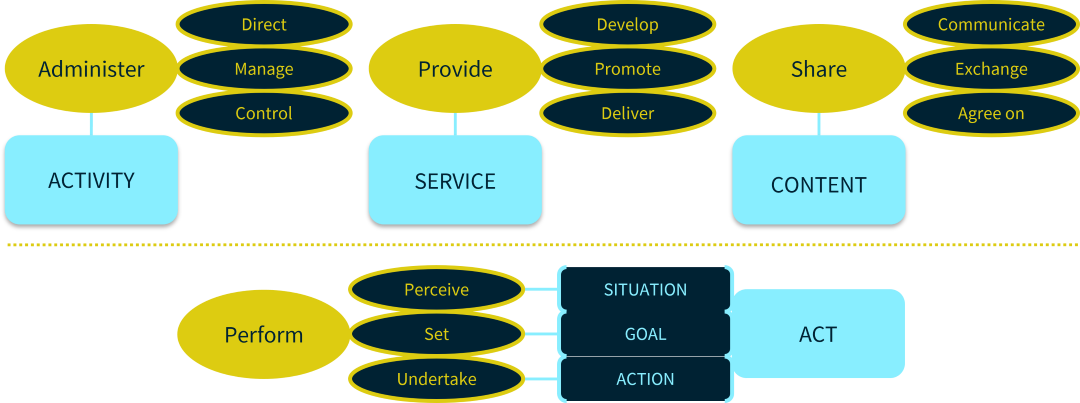
- Perform an act
- Perceive a situation
- Sense (e.g., see, hear, touch, smell, or taste)
- Interpret (i.e., understand)
- Evaluate (i.e., compare with a goal)
- Set a goal
- Formulate
- Consider (i.e., weigh pros and cons of)
- Accept
- Undertake an action
- Define
- Specify (i.e., visualize and detail)
- Effectuate
- Perceive a situation
- Share content
- Communicate content
- Send
- Receive
- Exchange content
- Inform [of]
- Reply [with]
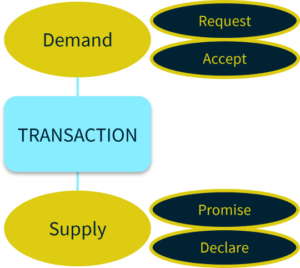
- Agree on content (in a transaction; see figure below)
- Demand
- Request
- Accept
- Supply
- Promise
- Declare
- Demand
- Communicate content
- Provide a service
- Develop a service
- Conceive
- Elaborate
- Implement
- Promote a service
- Introduce
- Position
- Offer
- Deliver a service
- Prepare
- Execute*
- Conclude
- Develop a service
- Administer an activity
- Direct an activity
- Designate
- Frame
- Allocate
- Manage an activity
- Plan
- Realize
- Evaluate
- Control an activity
- Steer
- Measure
- Adjust
- Direct an activity
In the design market, find contributing capabilities that your design organization does not deploy.
Determine the polarity of the effect of contributing capabilities on the indicators for ambition fulfilment:
- Positive
- Neutral (no effect)
- Negative
Classify contributing capabilities according to the kind of content:
Also classify contributing capabilities according to the nature of the content:
- Knowledge
(if explicit, that is, it can be formalized as a theory) - Experience
(if implicit, that is, it can be described as a case, but not formalized as a theory) - Intuition
(if tacit, that is, it can be documented as a behavior, but neither described as a case nor formalized as a theory)- Instinct (if innate)
- Acquirement (if learned)
Determine the current market position (i.e., the competitive advantage) of contributing capabilities:
- Equal advantage
- Not scarce or difficult to obtain in your design market
- Temporary advantage
- Unused advantage
- Scarce or difficult to obtain in your design market
- Hard to copy, mimic, or substitute in your design market
- Not available to all resources in your design organization
- Strategic advantage
- Scarce or difficult to obtain in your design market
- Hard to copy, mimic, or substitute in your design market
- Available to all resources in your design organization
Rank contributing capabilities on their expected merits for different aspects of your design organization.
- Reputation
- Organization strategy
- Stakeholder needs
- Technology
- Ethical conduct
- Regulatory
You may find a radar chart or spider web chart useful to visualize a rank.
Determine priorities for the construction of contributing capabilities in your design organization, based on their characteristics and rank:
- Now (i.e., to be done first)
- Next (i.e., to be done next, after the first)
- Later (i.e., to be done sometime after the next)
Acquire contributing capabilities that are not yet operative in your design organization (in case of strategic shifts, rapid growth, or performance gaps).
- Consult and learn theories or devise defensible theorems
(in case of knowledge) - Consult and study cases or conduct experiments
(in case of experience) - Observe and internalize behaviors or develop habits
(in case of acquirement) - Recruit and onboard new team members
(in case of instinct)
Specialize contributing capabilities that are operative but not yet exceptional (in case of underperformance, inefficiencies, or lagging progress) and therefore just give an equal advantage.
- Substitute
- Combine
- Adjust
- Modify
- Put to another use
- Eliminate
- Reverse
Furthermore, merge contributing capabilities that are operative and exceptional but just give a temporary advantage (because they are easy to copy, mimic, or substitute in your market).
- Join
- Unite
- Integrate
Capture and share contributing capabilities that are operative and distinctive but not yet collective (in case of unevenly distributed, fragmented, or vulnerable expertise) and therefore just give an unused advantage.
- Document, teach, and learn theories
(in case of knowledge) - Document, present, and study cases
(in case of experience) - Document, show, and internalize behaviors
(in case of acquirement) - Recruit and onboard new team members
(in case of instinct)
Conclusion phase
The steps in the conclusion phase of IAC focus on evaluating the fulfilment of your ambition:
Determine the outcome of fulfilling your ambition.
- Success: full achievement
- Default: partial achievement
- Failure: no achievement
Determine the causes of this outcome.
- Generate hypotheses
- Test hypotheses
- Confirm hypotheses
Decide on the next move to fulfil your ambition.
- Renewal
(if your ambition has been fulfilled) - Repetition
(if your ambition has not been fulfilled and still can be fulfilled) - Reformulation
(if your ambition cannot be fulfilled and needs to be adjusted)
IAC handbook: Example concepts
In this section, you will find a few example concepts below. They originate from scientific and professional literature and practical experience. From time to time, we will update this non-exhaustive overview.
Strategy. Combine scale with agility. — David Butler & Linda Tischler
System. Define a portfolio strategy, identify gaps and unmet or latent needs, and define segments for customers and users. — McKinsey Design
System. Define quantified metrics, build a holistic metrics system, and define supporting operational metrics. — McKinsey Design
System. Turbocharge processes, speed up internal feedback loops, and improve handoffs. — Invision Inside Design
System. Set goals, determine ground rules, and provide facilities to acquire, create, and shareknowledge. — UNStudio
System. Cultivate trust, give your people consistent support, and change up common routines every so often to create positive surprises. — User Experience
Strategy. Represent design at the top level of the organization, improve employee experience with design, and spread design practices. — McKinsey Design
Strategy. Build up your reputation, spot talent through your network, and establish a flexible talent pipeline. — Workable
System. Describe design work in terms of business goals, collect evidence of design results, and communicate the business value of design. — BoagWorld
System. Demonstrate desired behaviours, provide motivators, and recognize and acknowledge displayed behaviours. — PositivePsychology
Strategy. Translate the corporate vision into tangible goals, center the customer, foster collaboration, and uphold operational excellence—all while expanding creative limits. — Aquent
Strategy. Form a cross-disciplinary team, further knowledge integration, and implement decision-making through consensus. — Purdue University
Strategy. Let people explore the future, get familiar with it, and work together to address the resistant factors. — Livework
Strategy. Empathize, define, ideate, prototype, and test. — Stanford d.school
Strategy. To produce an innovative outcome for a complex challenge, iteratively explore, define, develop, and deliver. — the Design Council
System. Explore user experiences, discover user motives, and define user requirements. — Interaction Design Foundation
System. Recognize and remove overly complex content, organize knowledge, and filter content. — UX Collective
System. Bring ideas to fruition through a build-measure-learn feedback loop (Lean Startup). — Eric Ries
Background information
Preparation phase
To describe organizational results, IAC uses:
- For value: cost-benefit analysis.
- For impact: triple bottom line.
- For performance: performance management in business. See, for instance, Simon Kucher for an explanation.
For environmental factors, IAC prescribes the following analyses:
- Macro-environmental factors: PESTEL analysis. See, for instance, OnStrategy for an explanation with examples.
- Meso-environmental factors: Porter’s five-forces analysis. See, for instance, B2U for an explanation with examples.
- Micro-environmental factors: SWOT analysis. See, for instance, IMD for an explanation with examples.
To estimate whether an ambition can be fulfilled, IAC uses design thinking as popularized by IDEO. See, for instance, UX Design Institute for an explanation with examples.
Execution phase
IAC is based on McKinsey’s capabilities strategy for successful product development (2017).
For modeling activities, IAC utilizes various study models:
- Act: study model of purposeful action, developed by Norman (2002).
- Agree on content: study model of transaction, based on the DEMO methodology.
- Provide a service: service quality gap model.
- Promote: AIDA model for marketing.
- Manage an activity: PDCA (Plan, Do, Check, Act), also known as the Deming cycle.
For capabilities, IAC includes:
- To classify a capability’s kind: McKinsey 7S framework.
- To classify a capability’s nature: Knowledge types. See, for instance, Whatfix for definitions and examples.
- To determine a capability’s competitive advantage: VRIO analysis.
- To specialize a capability: SCAMPER.
- To capture a capability: Shadbolt & Smart (2015).
Other
See definitions for an explanation of terms used in this handbook. And below are links to our publications of supporting expertise and background knowledge.